Those Roadblock Words
Sometimes that bright orange cone in your lane is a good thing

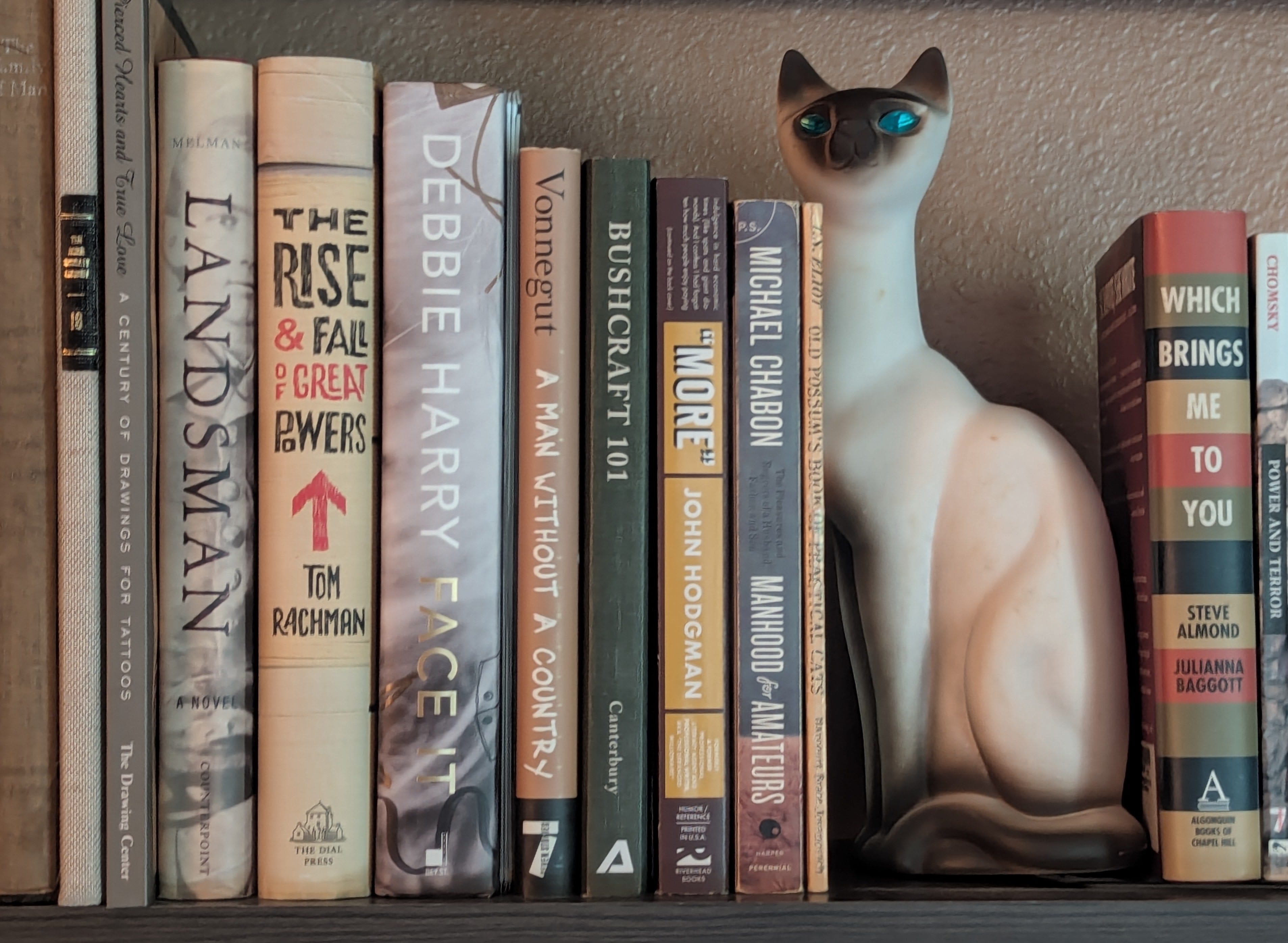
I have a large bookcase whose contents are arranged by color—aesthetically pleasing but comically difficult to find anything. Every once in a while, I’ll peruse it, looking for inspiration for my next library book.
Today I caught sight of Tom Rachman’s second book, The Rise and Fall of Great Powers: tan-colored spine, black and red lettering, Debbie Harry and Peter Melman hugging him on either side.
I wondered if I had missed his latest release. Sadly my deep dive told me no. Retired?! I can’t fault him; I too pivoted midcareer. But I don’t have fans.
Falling down a rabbit hole
So I took solace in an old review in The Guardian just to revisit that book a little bit. A snippet:
Other characters, whose relationships to each other and Tooly herself are obscure, start to appear. There's Sarah, a fortysomething flibbertigibbet who comes unpredictably in and out of the story, now love-bombing Tooly, now abandoning her.
Did you spot a word that jerked your head back?
I’ll save you the googling. The word has had a few past lives—used in Shakespeare’s King Lear, then in Sir Walter Scott’s Kenilworth, to name two—but as of the late 1800s, it seems a flibbertigibbet has meant “a silly, flighty person.”
The word itself sure sounds silly. Say it with me: flibber-tee-jib-it.
I see on Ngram that its search history soared in 2014—the same year the review was published—to a whopping 0.0000012541 percent. Those are my people!
I have some questions
I’ll venture to say that hardly anyone has heard of it, much less heard it in the wild. So why use it?
To share a writer’s affection for obscure vocabulary (#ThisPost)? To educate the less erudite (me)? To distract or intrigue people who can’t skate past it without finding out what the hell it is (me again, though it will billow out of my hippocampus like cigarette smoke, also erasing my desire to finish the original article)?
Will I ever use the word in conversation? Not if my goal is to communicate. I can’t imagine telling my son “Stay away from flibbertigibbets, would ya?”
(I’ve taken off my editor glasses, so I won’t mention readability or pacing to the gentleman whose byline still appears on the post eleven years later, who is the author of Write to the Point: How to be Clear, Correct and Persuasive on the Page [the irony!] and who also interviewed the effervescent Richard Ayoade—give him my best!)
ABC: Always Be Curious
I do adore tripping over mysterious words. I stop short, say it like I’m made of molasses–peanut butter, then hightail it over to a dictionary, where it feels as if I’m having a private conversation with Mr. Webster himself. Sometimes I hit the tiny speaker icon so the robot lady can read it back to me. And yes, my boy will run over and press it forty-five more times.
I couldn’t remember details from The Rise and Fall of Great Powers—namely the plot, the characters, the setting, the everything. But at least these little pauses force me to think and explore, hydrating my dusty brain.
They also remind me that learning should be a lifelong practice. When the thirst for clarity is stronger than the urge to forge ahead, you just have to go with it, like biting into an exotic fruit. How else would I possibly know about this oddity?
Do you have books or films you love but can’t quite remember why? Do you feel compelled to hunt down definitions to words you don’t know?
Now if someone could just contact Tom Rachman for me…
a few comments as a former dictionary collector: i learned flibertijibit from watching The Sound of Music as a kid! never heard/seen it elsewhere until now // one reason i like reading ebooks is the ease in which i can look up the definitions of words, just by long-pressing them // i’ve grown to love The Free Dictionary, discovered while working with an ELL student. you might love it too.